
Signal vs Threema: Free vs Paid Private Messenger
Published: October 7, 2026 · Updated: October 8, 2026
Most private-messenger comparisons are free versus free, which makes the business model a footnote. Here it is the headline. Threema charges you money, once, and that single fact shapes everything about it: no advertisers to please, no investors demanding growth, no need to monetize your attention. Signal achieves the same independence differently, through nonprofit status and donations. Two honest business models, two good apps, and a real choice between them.
from Signal's official site — file hosted by Signal, not by us
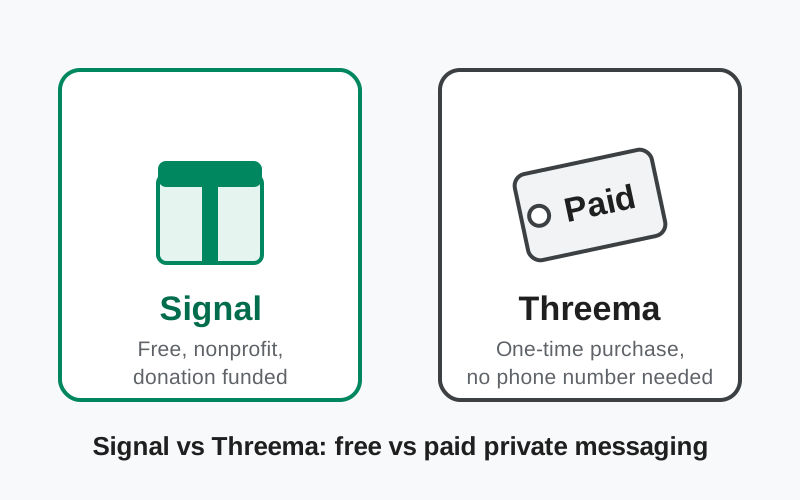
The two apps, side by side
| Signal | Threema | |
| Price | Free | One-time purchase (a few dollars; varies by region and store) |
| Owner | Signal Foundation, a US nonprofit | Threema GmbH, a Swiss company |
| Business model | Donations and grants | You are the customer: the purchase price funds development |
| Ads or data business | None | None |
| Identifier | Phone number required (usernames hide it from contacts) | No phone number or email; random Threema ID generated on device |
| Message encryption | End-to-end encrypted, everything, by default | End-to-end encrypted, everything, by default |
| Protocol | Signal Protocol: open and widely audited | Custom protocol, documented; clients are open source |
| Open source | Client open source; server code public | Apps are open source; server code is not fully public |
| Server location | United States | Switzerland |
| Metadata approach | Minimal by design | Minimal by design; contacts stay on your device |
| Network size | Large mainstream base | Smaller, concentrated in German-speaking Europe |
| Calls | Full voice/video calls, group calls, call links | Voice and video calls, more basic |
Look at the privacy rows and you will see how similar these two are. Look at the price, identifier, and network rows and you will see where the choice actually lives.
Price and business model: what "paid" actually buys
Threema costs a few dollars as a one-time purchase (the exact price varies by country and store). There is no subscription and no in-app upsell. That purchase is the business model, and it is worth appreciating what that means: Threema's developers answer to paying customers, not to advertisers or investors. When a company's revenue comes from the purchase price, its incentive is to make a product worth buying, and privacy is a selling point rather than a cost center.
Signal reaches the same independence from the other direction. As a nonprofit funded by donations and grants, it has no advertisers either and no one to sell data to. Both models are honest; they just distribute the cost differently. With Threema, every user pays a little. With Signal, a smaller number of donors pay for everyone.
The practical consequence of Threema's price is not the money, a few dollars is trivial, but the friction. Every person you want to talk to must also pay. In countries where Threema is popular, that is normal. Everywhere else, it is a real barrier: "install this free app" converts far better than "buy this app so we can chat." This is the main reason Threema's network stays smaller, and network size matters in messaging.
One more honest note: paying does not automatically mean more private. Threema's privacy comes from its design (no number, minimal data, encryption), not from the price tag. The price funds the design; it is not itself a privacy feature.
Identity: Threema ID vs phone number
This is Threema's standout feature and the reason many of its users chose it. When you first open Threema, the app generates a random Threema ID from a key pair created on your device. No phone number, no email address, no name. You can optionally link a number or email to help contacts find you, but it is optional, and many users never do. Your identity is a cryptographic key, not a phone record.
Signal, for all its privacy strengths, still anchors your account to a phone number. Usernames and number-privacy settings have reduced what that means in practice: you can now share a username instead of your number and control who sees it. But the number remains the root of the account, visible to Signal's servers and required at registration.
How much does this matter? For most people, Signal's current setup is fine: your number is hidden from contacts you do not trust, and Signal stores almost nothing else. But "almost nothing plus my phone number" is still more than "nothing at all." If your situation requires that no phone number be attached to your messaging identity, period, Threema satisfies that requirement and Signal does not. That is a clean, binary difference, and for some people it is the ention and metadata
Both apps encrypt everything end to end by default: one-to-one chats, group chats, voice calls, video calls, and shared media. Neither makes you opt in, and neither has a weaker "normal" mode. On this dimension, they are peers, and both are far ahead of mainstream messengers.
The protocols differ. Signal uses the Signal Protocol, which is open, widely studied, independently audited, and adopted by other apps. Threema uses its own protocol design, which it documents publicly, and its apps are open source so the implementation can be inspected. Threema's cryptography is well regarded, but it has not received the same depth of independent scrutiny as the Signal Protocol. In cryptography, the most-studied option carries less uncertainty, and that favors Signal, modestly but genuinely.
On metadata, both are minimalists. Signal stores your number, registration dates, and last connection time, and designs the rest (sealed sender, private contact discovery) to keep the servers blind. Threema keeps contacts on your device rather than uploading them, generates as little server-side data as possible, and likewise avoids building a social graph. Neither company has much to hand over when asked, and both have structured themselves so that is true.
Bottom line: if you graded both apps purely on "can the company read my messages or map my contacts," they would both score near the top of the industry. The differences between them are smaller than the gap between either of them and an ad-funded messenger.
Jurisdiction: Switzerland vs the United States
Threema's servers are in Switzerland, and the company leans on Switzerland's privacy reputation. Signal's servers are in the United States, under US law. Does this matter?
Honestly, less than marketing suggests. Jurisdiction matters most when a company holds data worth seizing; both companies hold very little, so there is less for any jurisdiction to reach. Switzerland's privacy laws are genuinely strong, and for some users and organizations, especially in Europe, a Swiss provider simplifies compliance conversations. The US has broader surveillance authorities, which is a legitimate mark against Signal in the abstract.
But weigh it proportionally. A company that stores almost nothing in the US gives authorities less than a company that stores a lot in Switzerland. Both Threema and Signal are in the first category. Jurisdiction is a reasonable tiebreaker if everything else is equal; it is not a reason to pick an otherwise worse fit.
Features compared, honestly
- Messaging: both excellent for the basics: text, media, voice notes, reactions, disappearing messages, polls. No meaningful gap for everyday use.
- Calls: Signal is stronger here: full voice and video calls, encrypted group calls, and shareable call links. Threema has voice and video calls, but they are more basic and the experience is less polished.
- Groups: both offer encrypted groups with admins. Signal's groups feel more modern; Threema's cover the essentials.
- Desktop and multi-device: both offer desktop apps linked to the phone. Neither matches the seamless cloud sync of a Telegram, because neither keeps your history on a server, which is the privacy price both chose to pay.
- Broadcasting and bots: neither app chases this. If you want channels and bots, you are looking at the wrong comparison; see our other comparisons.
- Business use: Threema offers a business version for organizations; Signal has nothing for businesses.
- Network effect: Signal's user base is much larger and more international. Threema is strongest in Switzerland, Germany, and Austria. Outside that region, finding contacts on Threema takes effort.
The pattern: Signal is the more complete, more modern-feeling product with the bigger network. Threema is the more single-minded privacy tool with the cleaner identity model. Neither is trying to out-feature the mainstream; both are trying to be trustworthy.
Who should pick which
| Your situation | The honest pick |
|---|---|
| No phone number attached to messaging, full stop | Threema. Random ID, no number or email required. Signal cannot offer this. |
| You want the best free private messenger | Signal. Nearly everything Threema offers, free, with a bigger network. |
| Swiss jurisdiction matters to you or your organization | Threema. Servers and company in Switzerland. |
| Group calls and call links matter | Signal. Clearly stronger calling features. |
| You are in German-speaking Europe | Threema has real network density there; elsewhere, Signal. |
| You prefer paying once over depending on donations | Threema. You are the customer, and the model is refreshingly simple. |
| Non-technical family members | Signal. Free to install removes the biggest adoption barrier. |
If you are still unsure, try this rule of thumb: if the words "no phone number" were the reason you started reading, get Threema. For almost every other reason, get Signal. Either way, you will be using one of the two most trustworthy messengers in existence, which is a better outcome than most people get.
Going with Signal on a phone without the Play Store? Our Signal APK download guide shows how to get the official build and verify it, and Signal APK vs Play Store explains the two official builds.
Frequently asked questions
Is Threema really private if I have to pay for it?
Yes. The payment is a one-time purchase that funds development; it is not a subscription and involves no data collection. Threema needs no phone number or email, encrypts everything end to end, and keeps contacts on your device.
Is Signal or Threema more private?
They are peers. Threema wins on identity (no phone number required); Signal wins on protocol scrutiny (the Signal Protocol is more widely audited). Both encrypt everything by default and collect minimal metadata. Either is far more private than ad-funded messengers.
Why does Threema cost money while Signal is free?
Different funding models for the same goal: independence. Threema sells the app once; Signal is a nonprofit funded by donations. Both avoid advertising and data businesses entirely.
Can Threema and Signal users message each other?
No. They are separate networks. You need the same app as your contact.
Does Threema work without a SIM card?
Yes. Since Threema needs no phone number, it works on Wi-Fi-only devices. Signal normally needs a number for registration (it is testing number-free accounts, but that is still in beta).
Which is better for businesses?
Threema offers a dedicated business version; Signal has no business tools. For personal privacy, compare them on the criteria above instead.
Related guides
- All Signal comparisons: the full compare hub
- Signal vs WhatsApp: the metadata debate
- Is the Signal APK safe?: honest safety assessment
- Download the official Signal APK: verified download walkthrough