
Signal vs Viber: an Honest Comparison
Published: October 7, 2026 Updated: October 8, 2026
This comparison has a trap in it, and the trap is the word "encryption." Both apps will tell you your messages are encrypted, and both are telling the truth. But they mean different things by it, and the difference is the entire comparison. Viber encrypts your messages on the way to its servers. Signal encrypts them so that nobody, including Signal, can read them at all. One of those is transport security. The other is end-to-end encryption. They are not the same thing, and marketing hopes you will not notice.
from Signal's official site — file hosted by Signal, not by us
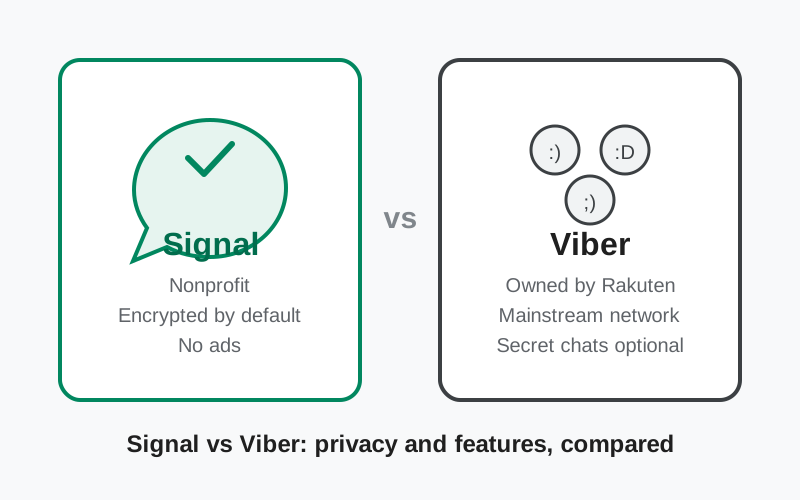
The two apps, side by side
| Signal | Viber | |
| Owner | Signal Foundation, a US nonprofit | Rakuten, a Japanese tech and commerce group |
| Business model | Donations and grants; no ads, no data business | Commercial: advertising, stickers, and paid calling features |
| Default chat encryption | End-to-end encrypted, every chat and call | Encrypted in transit; not end to end |
| Optional end-to-end encryption | Not needed: it is already the default | Secret chats: end-to-end encrypted, per conversation, one device |
| Open source | Client app open source (AGPLv3) | Closed source |
| Registration | Phone number (usernames hide it from contacts) | Phone number |
| Network | Large and growing globally | Very large in its strong regions: Eastern Europe, the Middle East, parts of Asia |
| Stickers, communities, extras | Basics done well; no broadcast channels | Rich sticker store, communities, and fun features |
| Ads | None | Advertising and promoted content in a commercial app |
The row that matters most is the encryption row, and it needs more than a table cell. Let us unpack it properly.
What "encrypted" means on each app
When Viber says your messages are encrypted, it means they are protected while traveling between your phone and Viber's servers. That stops eavesdroppers on your Wi-Fi or your internet provider from reading them, which is genuinely valuable. But Viber's servers can see the content. The company, anyone with access to its systems, and anyone who compels the company can too.
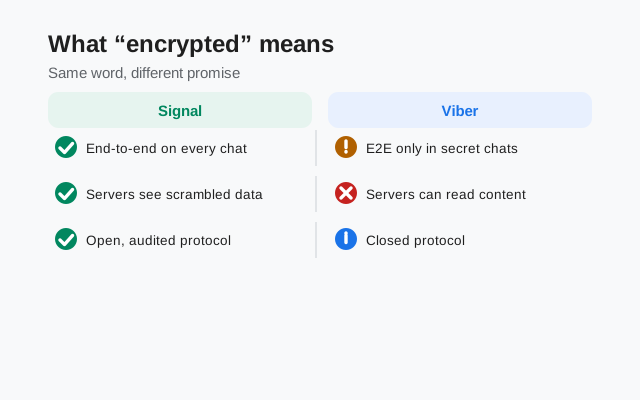
When Signal says your messages are encrypted, it means end-to-end encryption: only you and the person you are talking to hold the keys. Signal's servers relay scrambled data they cannot read. That is a fundamentally stronger promise, and it is why Signal can truthfully say it has almost nothing to hand over when governments ask for user data.
Viber does offer end-to-end encryption in secret chats, and credit where it is due: the cryptography there is real. But notice the design. Secret chats are optional, per conversation, limited to a single device, and separate from your normal chats. Most Viber users never open one. A privacy feature that almost nobody uses is barely a privacy feature. Signal's approach is the opposite: encryption is not a mode you turn on. It is the only mode.
So the honest statement is this: Viber protects your messages from outsiders on the network. Signal protects them from everyone except the person you sent them to. For casual chatting the difference may never bite you. For anything sensitive, it is everything.
Where Viber is genuinely strong
It would be lazy to dismiss Viber as "the worse Signal." In the places where Viber won, it won for reasons that have nothing to do with cryptography.
The network is the product
In several countries across Eastern Europe, the Middle East, and parts of Asia, Viber is not an app people chose after careful comparison. It is the default. Your relatives, your colleagues, the plumber, the school group: they are on Viber. Signal's privacy advantages mean nothing if the conversation you need to have is happening over there. Network effect is the most honest argument any messenger has, and Viber has it in its territories.
It is fun to use
Viber invested heavily in stickers, GIFs, communities, and the playful layer of messaging that Signal deliberately keeps thin. For many people, messaging is social play, not secure communication, and Viber serves that joy better. There is nothing wrong with wanting your chat app to be delightful.
Communities and broadcast features
Viber Communities give groups a home with more structure than a plain group chat, and the app has spent years building features for public and semi-public conversation. Signal has no broadcast channels by design. If you follow creators or run a community, Viber offers things Signal simply does not.
Calling beyond the app
Viber has long offered paid calls to regular phone numbers, which is useful when the person you need to reach is not on any messenger at all. Signal calls only reach other Signal users.
Viber's strengths are all about reach, fun, and everyday practicality. Dismissing them because the encryption model is weaker is the kind of purism that leaves you messaging nobody.
Where Signal is genuinely stronger
End-to-end encryption everywhere, by default. Every chat, every group, every voice and video call. No special mode, no per-conversation opt-in, no device limitations. This is the core of the comparison and Signal wins it outright.
A nonprofit with nothing to sell. Signal Foundation exists to provide private communication, funded by donations. Rakuten owns Viber as part of a commercial portfolio, and commercial portfolios need returns: advertising, promoted content, data synergies. Neither company is villainous, but their incentives point in different directions, and incentives shape products over time.
Open source, so claims can be checked. Signal's Android client is open source. Independent researchers read it. Viber's code is closed, so its security claims rest on trust in the company. Trust is not worthless, but verification is better, especially from a company whose business is not privacy.
Minimal metadata. Signal is engineered to know almost nothing about who talks to whom. A commercial messenger with advertising interests collects more by nature: usage patterns, device data, and the social graph that makes ad targeting work. The message content may be encrypted in transit on Viber, but the metadata around it is a commercial asset.
No ads, no promoted content, no upsells. Signal is quiet. It does not try to sell you stickers, show you ads, or keep you scrolling for someone else's benefit. That restraint is a feature.
Ownership and the business model behind the app
Comparisons usually stop at features, but ownership is where long-term privacy is decided. Signal is run by a nonprofit foundation whose mission is private communication. If Signal started showing ads or harvesting data, it would be betraying its reason to exist, and its donors and users would revolt. The structure itself is a guardrail.
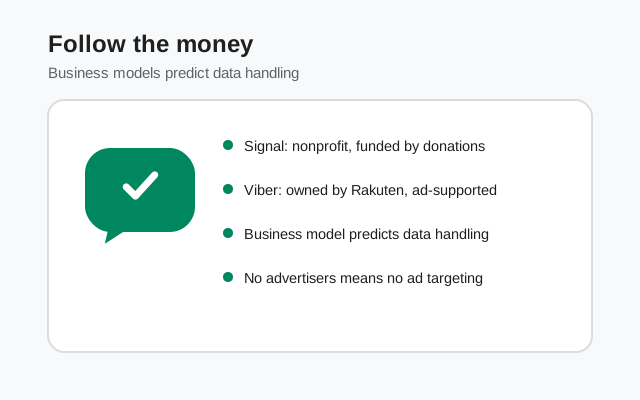
Viber sits inside Rakuten, a large commercial group spanning e-commerce, finance, and telecom. Viber's job inside that portfolio is to be a successful consumer product, and successful consumer products in 2026 monetize attention and data. That does not mean Viber is spying on your messages today. It means the company's incentives reward engagement and data collection, while Signal's reward the opposite.
Ask yourself a simple question: if privacy regulation weakened tomorrow, which app's behavior would change? The nonprofit whose mission is privacy, or the commercial product inside a conglomerate? Structures do not guarantee outcomes, but they predict them better than promises do.
Who should pick which
| Your situation | The honest pick |
|---|---|
| Privacy is the priority | Signal. Default end-to-end encryption, nonprofit, minimal data. Not close. |
| Everyone you know uses Viber and will not switch | Viber for daily life. A messenger without your people is a diary. Use secret chats for anything sensitive. |
| You want fun: stickers, communities, playful chats | Viber. It invested in delight; Signal invested in privacy. |
| You are a journalist, activist, or handle sensitive work | Signal. Default encryption plus minimal metadata is the safer combination. |
| You need to call regular phone numbers | Viber (paid calling to non-app numbers). Signal only calls Signal users. |
| You hate ads in your messenger | Signal. No ads, no promoted content, ever. |
| You want both worlds | Run both. Viber for the network you cannot leave, Signal for the conversations that deserve real privacy. Millions of people do exactly this. |
The pattern across every honest messenger comparison is the same: the private app wins on privacy, the mainstream app wins on network. Your contacts decide more than the cryptography does.
If Signal is your pick and your phone has no Play Store, install the official build from Signal: our Signal APK download guide shows the verified steps. For the other mainstream comparison, see Signal vs WhatsApp.
Frequently asked questions
Is Viber end-to-end encrypted?
Only in optional secret chats, which you must start deliberately and which stay on one device. Regular Viber chats are encrypted in transit but not end to end. Signal encrypts every chat and call end to end by default.
Who owns Viber?
Rakuten, the Japanese e-commerce and tech group. Signal is owned by the nonprofit Signal Foundation. Ownership shapes the business model: Rakuten runs Viber as part of a commercial portfolio, while Signal has no ads or data business.
Is Viber safe to use?
For everyday chatting, Viber is a legitimate mainstream app, not a scam. But its privacy design is weaker than Signal's: default chats are not end-to-end encrypted, the code is closed, and it collects more data as part of a commercial business.
Why do people still use Viber?
Network effect. In several regions Viber is the default messenger, with stickers, communities, and calling features people like. The best messenger is often the one your contacts already use.
Does Viber have ads?
Viber is a commercial product with advertising and promoted content in some areas, unlike Signal, which has no ads at all.
Can I use Signal and Viber on the same phone?
Yes. They are separate apps, and many people keep Viber for contacts who only use it while moving private conversations to Signal.
Related guides
- All Signal comparisons: the full compare hub
- Signal vs WhatsApp: the other mainstream giant, compared
- Signal vs Telegram: encryption models and feature trade-offs
- Signal vs Messenger: Meta's messenger vs the nonprofit alternative