
Is Signal HIPAA compliant? The caveat every clinician should read
Published: October 7, 2026
The honest answer up front: Signal is not HIPAA-compliant, and using it for patient information does not satisfy HIPAA's requirements. Signal offers no Business Associate Agreement, holds no healthcare certification, and provides no compliance tooling. Some clinicians still use it informally for quick coordination, and the encryption is genuinely strong, but strong encryption is not the same as compliance. This page explains the difference plainly: what HIPAA actually requires of a messaging tool, why Signal falls short, and what the compliant path looks like. We are not lawyers or compliance officers; your compliance officer's word governs.
from Signal's official site — file hosted by Signal, not by us
What HIPAA actually requires of a messaging tool
HIPAA's requirements for electronic protected health information are administrative, technical, and contractual, and all three matter. Start with the contractual piece, because it is the clearest. A covered entity may only share protected health information with a vendor that has signed a Business Associate Agreement. In that contract, the vendor accepts specific duties around safeguarding the data, reporting breaches, and submitting to audits. No BAA, no compliant data sharing. This is not a technicality; it is the mechanism by which responsibility is assigned.
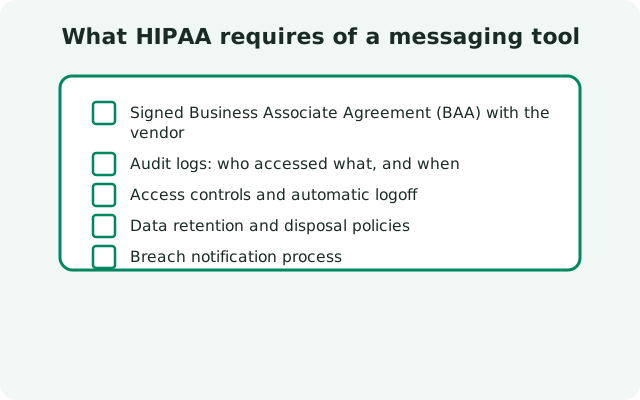
The technical requirements include access controls (only the right people see the data), audit controls (records of who accessed what), integrity controls (protection against improper alteration), and transmission security. An encrypted chat app covers transmission security well and little else. Audit controls in particular are a gap for consumer messengers: HIPAA expects the organization to be able to show who accessed information and when, and a chat app with no admin console cannot produce that.
The administrative side includes risk assessments, policies, training, and incident response. A compliant messaging setup is not just an app; it is an app plus the paperwork and processes around it. Any honest discussion of "is this tool HIPAA-compliant" has to cover all three layers, because a tool can be excellent at one layer and disqualified by another.
Where Signal falls short, specifically
Against those requirements, Signal's position is straightforward. Signal does not offer a Business Associate Agreement. There is no business tier, no enterprise contract, and no healthcare program to sign one under. Without a BAA, a covered entity cannot compliantly route protected health information through the service, regardless of how strong the encryption is. This single fact settles the compliance question for most organizations.
Beyond the BAA, the structural gaps line up with the requirements above. There is no admin console, so there is no centralized access control, no user provisioning or deprovisioning, and no audit trail of who accessed what. There is no retention management, so the organization cannot demonstrate the records controls HIPAA expects. There is no support contract and no breach-notification process aimed at covered entities. These are not oversights; Signal is a consumer privacy app, and it was never built to be a healthcare vendor.
None of this is a criticism of Signal's security. The encryption is genuinely excellent, and for pure confidentiality against eavesdroppers it outperforms many nominally "compliant" tools. But compliance is not a synonym for security. Compliance is security plus contracts plus auditability plus process, and Signal supplies only the first. Conflating the two is the most common mistake in this conversation.
Why some clinicians still use it informally
And yet clinicians do use Signal, widely enough that the question keeps coming up. The reasons are practical, not legal. Hospital pagers are terrible. Approved messaging systems are often slow, clunky, or absent, especially across organizations. A doctor who needs to reach a colleague about a patient right now reaches for the tool that works, and Signal works: fast, reliable, encrypted, on every phone.
The typical informal pattern is coordination without identifiers: "the patient in bed 4 needs the labs rechecked," shift handoffs stripped of names, quick "call me" messages between colleagues. Clinicians using it this way are usually trying to keep protected information out of the chat, using Signal for the logistics around care rather than for the clinical data itself. Whether even this is acceptable depends on the organization's policies and risk tolerance, which is why the compliance officer has to be in the conversation.
Be clear-eyed about what this is: a workaround driven by bad approved tools, not a compliance strategy. It persists because the alternative in many settings is worse communication, and worse communication harms patients too. The honest framing is a trade-off between two risks, and it deserves an honest organizational decision rather than a quiet habit nobody documented. If your organization runs on this workaround, the fix is better approved tooling, not pretending the workaround is compliant.
Informal use vs real compliance: what's different
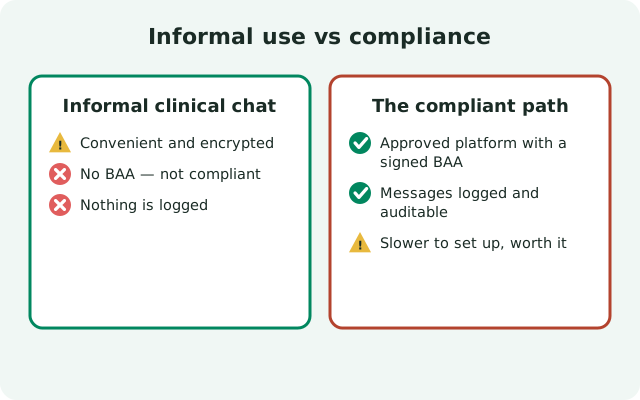
The distinction in one table, because it is the whole page in miniature.
| Question | Informal clinical use | HIPAA compliance |
|---|---|---|
| Is the encryption strong? | Yes, end-to-end by design | Required, and Signal meets this part |
| Is there a signed BAA? | No | Required; absent here |
| Can the org audit access? | No admin console, no audit trail | Required; absent here |
| Can the org control accounts? | No provisioning or deprovisioning | Required; absent here |
| Are retention rules enforceable? | No central retention controls | Required; absent here |
| Is there breach-notification process? | No vendor process for covered entities | Required; absent here |
One row passes; five do not. That is the honest scorecard. Anyone telling you the first row is the whole test is either mistaken or selling something. Compliance officers reading this table will recognize it instantly, which is why the table, not the encryption, should lead any internal discussion.
The risks, honestly
What actually happens when clinicians use Signal informally? Honesty requires saying that enforcement attention tends to focus on breaches and complaints, not on quietly competent informal use, and that many organizations tolerate the workaround while pushing toward approved tools. It also requires saying that tolerance is not approval, and that the risk concentrates in specific scenarios.
The scenarios that create real exposure:
- Patient identifiers in chats (names, photos, record numbers) rather than stripped-down coordination.
- A lost or stolen phone with an unlocked chat history.
- A departing staff member who keeps access to group chats full of clinical discussion.
- A dispute or investigation where chat history is requested and the organization cannot produce or account for it.
Each of these is preventable with policy, and each of them happens regularly in organizations running on undocumented workarounds.
The other risk is subtler: normalization. When informal Signal use becomes the way the unit communicates, nobody remembers it was supposed to be temporary, the approved system atrophies further, and the organization drifts into depending on a tool it cannot govern. The fix is a decision, documented: either approve and govern the tool properly, which with Signal means accepting its limits, or invest in the compliant platform and migrate. Drifting is the choice that maximizes risk.
How to comply instead
So what should an organization actually do? How to comply instead has three steps, none of which involve pretending Signal is something it is not.
First, talk to your compliance officer before adopting anything. Not after the team is already on it, before. Bring this page's scorecard to the conversation. A good compliance officer will not be surprised by any of it; they will be relieved someone did the homework.
Second, evaluate purpose-built compliant platforms. Compliant messaging platforms exist: tools built for healthcare with signed BAAs, admin consoles, audit trails, and retention controls. We do not endorse specific products here, deliberately; the right choice depends on your organization's size, systems, and budget, and your compliance officer and IT team should run the evaluation. What matters is that the evaluation happens against HIPAA's actual requirements, not against "it has encryption."
Third, write the interim policy. Migration takes time, and clinicians still need to communicate today. An honest interim policy says what is allowed in the meantime: no patient identifiers in informal chats, disappearing messages on for coordination threads, immediate reporting of lost devices, and a named date for revisiting. An interim policy the organization actually wrote beats a workaround nobody documented, every time.
One thing the compliant path is not: it is not "use Signal but carefully and call it compliant." Careful use reduces risk; it does not create compliance. Keep those two ideas separate and every conversation about this topic gets easier.
What Signal can't do for you
The limits, healthcare edition.
Signal cannot sign a BAA. No business tier exists to sign one under. This alone disqualifies it for handling protected health information under HIPAA.
Signal cannot give your organization audit or access controls. No admin console means no audit trail, no provisioning, no deprovisioning. Compliance requires all three.
Signal cannot manage retention for you. Disappearing messages are a privacy feature, not a records system, and in a healthcare context auto-deletion without a retention policy behind it is a liability.
Signal cannot protect a lost or shared device. Clinical chats on an unlocked phone are readable by whoever holds it. Device lock screens, short timers, and minimal identifiers are mitigations, not solutions.
Signal cannot be your compliance officer. This page is general information, not legal or compliance advice. Organizational decisions about patient data belong to your compliance officer and counsel, full stop.
Frequently asked questions
Is Signal HIPAA compliant?
No. Signal offers no Business Associate Agreement, no healthcare certification, and no compliance tooling such as audit trails or admin controls. Strong encryption alone does not make a tool HIPAA-compliant.
Can doctors use Signal to text about patients?
Without a BAA and compliance controls, routing protected health information through Signal does not satisfy HIPAA. Some clinicians use it informally for stripped-down coordination, but that is a workaround, not compliance, and it needs an organizational decision.
Does end-to-end encryption make Signal compliant?
No. Encryption covers one technical requirement. HIPAA also requires a signed BAA, audit controls, access management, and administrative processes, none of which Signal provides.
What should a clinic use instead?
Purpose-built compliant messaging platforms exist with signed BAAs, admin consoles, and audit trails. We do not endorse specific products; your compliance officer and IT team should evaluate options against HIPAA's actual requirements.
We already use Signal informally. What now?
Do not panic, but do not drift either. Talk to your compliance officer, write an interim policy (no patient identifiers in chats, short disappearing timers, lost-device reporting), and plan the migration to a compliant platform.