
Signal's Independent Security Audits: An Honest Overview
Published: October 7, 2026 · Updated: October 8, 2026
When people ask whether Signal has been audited, they are really asking whether anyone trustworthy has checked the claims. "End-to-end encrypted" is easy to say and hard to verify, so an independent audit, where outside experts are paid to attack the code and publish what they find, is the closest thing the industry has to an answer. This guide explains what Signal's audits cover, what they actually prove, and how to read them without over- or under-trusting them.
from Signal's official site — file hosted by Signal, not by us
What has been audited
Signal has commissioned independent security audits across its history, covering both the Signal Protocol (the encryption design used by Signal and adopted by other messengers) and the apps themselves. The reports are published on Signal's own site along with Signal's responses, which is the part many projects skip.
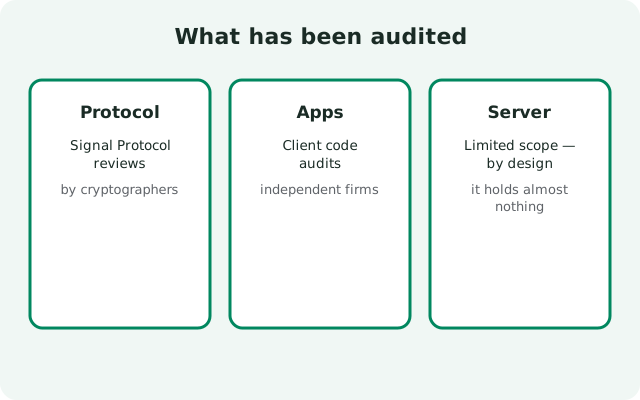
A few things to know about the scope:
- Protocol audits review the cryptographic design: the key exchange, the ratcheting that gives forward secrecy, and the authentication. These ask whether the math and the protocol logic hold up.
- Implementation audits review the actual app code: how keys are stored on your phone, how the app handles edge cases, whether the code matches the protocol spec.
- Follow-up reviews check whether the issues found earlier were actually fixed, which closes the loop instead of leaving findings as open questions.
We deliberately do not list firm names, dates, or finding counts here, because those details change with every audit round and go stale fast. The durable facts are the pattern: independent auditors, published reports, public responses, repeated over time. For the current list and the actual PDFs, go to the source: Signal's official site and Signal's blog, where the reports are posted.
What an audit proves (and what it does not)
| An audit proves… | An audit does not prove… |
|---|---|
| Independent experts read the code in depth, at a specific point in time | That every line of the current code is flawless |
| The issues found were real enough to report | That all issues were found (audits sample; they do not exhaust) |
| Signal fixed the reported issues (check the follow-up reports) | That future updates will not introduce new bugs |
| The protocol design withstood expert cryptanalysis | That your phone itself is secure (malware on your device sees messages before encryption) |
| The project is willing to be scrutinized publicly | That you should skip your own checks before installing |
The honest summary: an audit is a strong positive signal, not a certificate of perfection. No serious security professional reads "audited" as "unhackable." They read it as "experts tried hard to break this and published what happened."
How to read an audit report in ten minutes
Audit PDFs look intimidating, but you only need four sections:
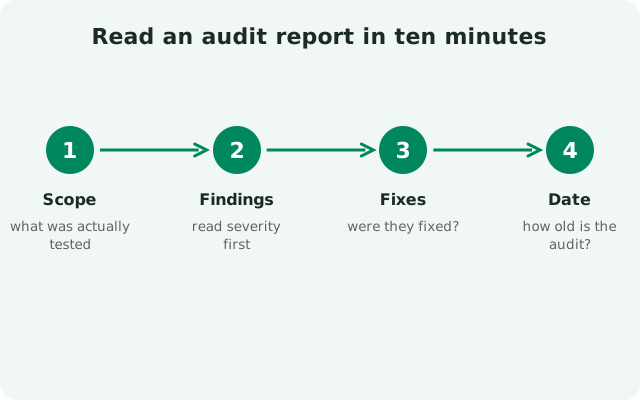
- Scope. What exactly was reviewed, and which version? A protocol audit from years ago does not cover last month's app rewrite. Check that the scope matches what you care about.
- Findings by severity. Every audit finds things. That is normal and healthy; an audit that finds nothing is more suspicious than one that finds issues. Look at the severity ratings: critical and high findings matter, informational notes mostly do not.
- The vendor response. Did Signal acknowledge each finding and fix it? The follow-up section (or a later re-audit) tells you whether the loop was closed. This is the single most informative part.
- Limitations. Auditors state what they did not cover, often in the first pages. Read it so you do not credit the audit with more than it claims.
If you take nothing else away: an audit with published findings and published fixes is the good outcome. Silence would be the bad one.
The track record that matters more than any single audit
One audit is a snapshot. Signal's real trust case is the combination around it:
- Open-source clients. The Android, iOS, and desktop app code is public under open licenses, so anyone can inspect it at any time, not just during an audit window. The server code is also published. Closed competitors cannot offer this at all.
- Repeated audits over years. A project audited once and never again is coasting on old news. Signal has returned for further reviews as the code evolved.
- Public fixes. Findings were addressed and the fixes were published, which is the behavior you want from a security-conscious project.
- Protocol adoption under scrutiny. The Signal Protocol is also used by other major messengers, which means far more cryptographers have stared at it than any single audit could arrange.
No other mainstream messenger combines all four. That does not make Signal magic; it makes the trust case checkable instead of faith-based.
Why publishing the findings matters
Plenty of companies get audited and keep the report in a drawer. Signal publishes its reports and its responses, and that choice is itself informative:
- It lets outsiders check the fixes. A claim of "we fixed everything" is cheap; a published report lets researchers confirm it.
- It sets the severity honestly. Every audit finds issues, and publishing them means accepting short-term embarrassment for long-term credibility. Projects with something to hide do the opposite.
- It builds a public record. Year after year of published audits and fixes is a track record you can inspect. A single private audit is a claim you have to take on faith.
When you evaluate any messenger's security claims, ask not just "were you audited" but "where is the report, what did it find, and what did you fix." Signal answers all three in public. Most competitors cannot answer even the first.
The honest limits
To keep this guide honest, here is what audits cannot do for you:
- They do not secure your device. If your phone has spyware, it reads messages before encryption happens. No audit of Signal's code changes that. Keep your OS updated and be careful what you install.
- They do not cover the future. An audit of last year's code says nothing about code written since. This is why repeated audits matter more than any single one.
- They do not replace verifying your download. Audited code does not help if you install a repackaged fake. Always verify the APK signature against the fingerprint on Signal's download page before installing; our guide to verifying the SHA-256 fingerprint walks through it.
Bottom line: Signal's audits are genuine, published, and repeated, which puts it ahead of nearly every competitor. Treat them as strong evidence, not as a warranty, and pair them with the basics: download from the official page, verify the signature, keep your device clean. More on the practical side: is the Signal APK safe and has Signal ever been hacked.
Frequently asked questions
Has Signal's encryption ever been broken in an audit?
No publicly known audit has broken the core Signal Protocol's encryption. Audits have found and reported implementation issues, which is exactly what audits are for, and Signal has addressed the reported findings.
Where can I read Signal's audit reports?
Signal publishes audit reports and summaries on its own site, signal.org, and discusses them on its blog. Always read the primary report rather than a news summary if you want the details.
Does an audit mean Signal is 100% secure?
No. An audit means independent experts reviewed a specific version of the code at a specific time and reported what they found. It greatly raises confidence, but no audit can prove the absence of all bugs.
Why do audits matter if the code is open source?
Open code means anyone can look, but few people actually do a deep structured review. A commissioned audit pays independent experts to do exactly that, systematically, and to publish what they found.
Related guides
- our safety guides hub: all verification and safety walkthroughs in one place
- Has Signal ever been hacked?: the honest incident history
- Who owns Signal?: the nonprofit structure behind the audits
- Is the Signal APK safe to install?: the full safety assessment
- Verify the Signal APK SHA-256 fingerprint: make sure your copy is the audited code