
Who Owns Signal? The Nonprofit Structure, Explained
Published: October 7, 2026 Updated: October 8, 2026
"Who owns Signal" is one of the most important questions you can ask about any messenger, because ownership decides incentives. A company owned by shareholders must eventually turn users into revenue. A nonprofit with no ad business has no such pressure. This guide explains Signal's actual structure, why it is set up that way, and where the honest limits of "nonprofit" as a trust signal are.
from Signal's official site — file hosted by Signal, not by us
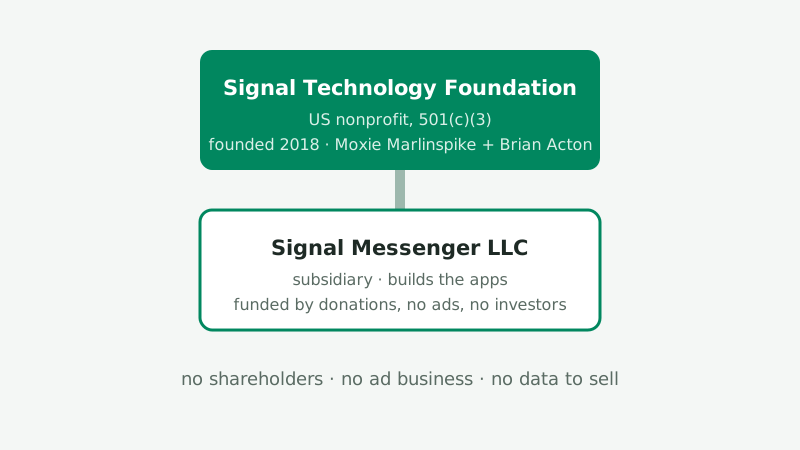
The structure: foundation plus subsidiary
Signal's organization has two layers, and both are public:
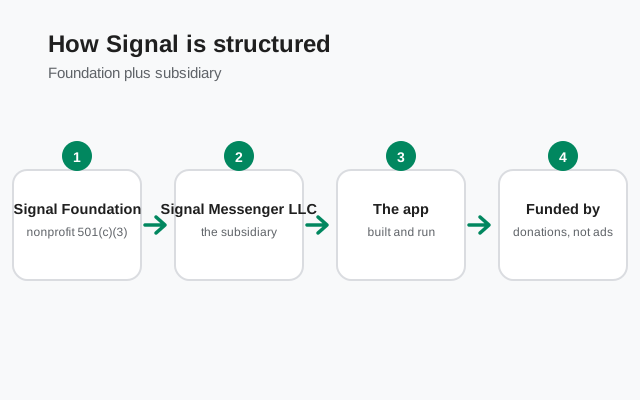
- Signal Technology Foundation, a US nonprofit organization (a 501(c)(3) tax-exempt charity). The foundation owns the mission: developing open-source privacy technology. As a nonprofit, it has no owners in the business sense and no shareholders. Its assets are legally dedicated to its charitable purpose.
- Signal Messenger LLC, a subsidiary of the foundation. This is the operating company that employs the developers and runs the Signal service day to day. Being an LLC under a nonprofit parent is a common setup: it lets the project operate like a tech company while the nonprofit parent keeps control of the mission.
The practical effect: there is no parent tech giant, no venture capital firm with a board seat, and no investor waiting for an exit. Nobody can buy Signal the way Facebook bought WhatsApp, because a nonprofit's assets cannot be sold off for private profit.
The founders and the $50 million seed
The foundation was created in 2018 by two people whose backgrounds explain a lot about Signal's priorities:
- Moxie Marlinspike, the cryptographer and security researcher who created the Signal Protocol and led Signal's development for years. The protocol that secures Signal's messages is his design.
- Brian Acton, the co-founder of WhatsApp. He left Facebook in 2017 over disagreements about monetizing WhatsApp, then seeded the Signal Technology Foundation with a $50 million interest-free loan to build a messenger that would never face that pressure.
That origin story matters because it is the opposite of the usual startup arc. Acton had already built one of the world's biggest messengers, watched it get absorbed into an ad business, and then funded an alternative designed so that story could not repeat.
How Signal pays its bills
Running a global messenger is expensive: servers, bandwidth, and a full-time engineering team. Signal covers it without the usual revenue streams:
- User donations. The app periodically asks users to donate, and many do. This is the core ongoing funding.
- Grants and major gifts. Foundations and individuals contribute larger amounts.
- The initial seed funding from Brian Acton, which got the project off the ground.
What is absent: advertising, data licensing, premium features that monetize attention, and investor capital. Signal's privacy policy and public statements are consistent on this, and the nonprofit's tax filings are public records in the US, which adds a layer of financial transparency most tech companies never offer.
What the nonprofit filings tell you
One underused advantage of the nonprofit form is that the finances are public. In the US, 501(c)(3) organizations file annual Form 990 returns, which anyone can read. For Signal, those filings show where the money comes from and where it goes: overwhelmingly donations in, engineering and infrastructure out.
Why should you care as a user? Because it closes a common loophole. A for-profit messenger can claim "we respect your privacy" while its real customers are advertisers; you would never see the contradiction in its accounts. With Signal, the revenue line is donations, and if a data-selling business ever appeared, it would show up in public filings. That does not make fraud impossible, but it makes it much harder to hide, which is exactly what you want from an organization asking for your trust.
If you ever want to verify the funding story yourself instead of taking anyone's word for it, including ours, the filings are the primary source. Search ProPublica's Nonprofit Explorer for "Signal Technology Foundation" to find them. Look for total revenue, the share from contributions versus any commercial income, and executive compensation. Boring documents, but they are the receipts behind the "nonprofit" claim.
Why the nonprofit form matters for your privacy
Most privacy failures are not technical; they are business-model failures. A company that makes money from ads has a structural reason to collect data, keep it, and find new ways to use it. Every privacy promise such a company makes fights against its own revenue.
Signal's structure removes that fight at the root:
- No ad business means no reason to profile you. Signal cannot sell what it does not collect, and it has no incentive to start.
- No investors means no growth-at-all-costs pressure. Nobody is demanding the user base be "monetized" by next quarter.
- Minimal data by design. Signal famously keeps almost nothing: no message contents (it cannot read them anyway), minimal metadata, and features like sealed sender that reduce even that. When governments request data, there is little to hand over, which has been demonstrated in practice.
Nonprofit vs for-profit messengers
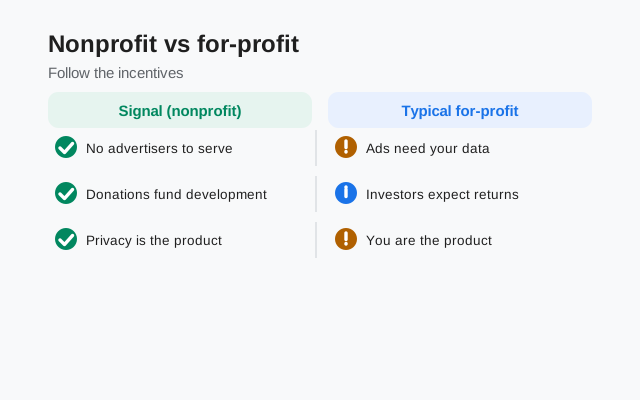
| Signal (nonprofit) | Typical for-profit messenger | |
|---|---|---|
| Owners | None (charitable foundation) | Shareholders / parent company |
| Revenue | Donations and grants | Ads, data, or ecosystem lock-in |
| Investor pressure | None | Constant: growth and monetization |
| Can it be acquired? | Effectively no (assets locked to mission) | Yes, like WhatsApp was |
| Data collection incentive | None: data is a cost, not an asset | Strong: data feeds the business |
| Financial transparency | Nonprofit filings are public | Usually minimal |
The honest limits of nonprofit trust
Nonprofit status is a strong structural signal, but this guide stays honest about what it does not guarantee:
- Nonprofits can still be breached. Good intentions do not patch servers. Signal's security record, including its independent security audits and its incident history, is the evidence to weigh alongside the structure.
- Nonprofits can still be mismanaged. Donation funding is not infinite. If donations dried up, Signal would face hard choices like anyone else. That has not happened, but the model depends on continued user support.
- Structure does not replace verification. Trust the nonprofit form, the open-source code, and the audits together, not any one of them alone. And whatever you trust, still verify what you install: check the APK signature against the fingerprint on Signal's download page with our fingerprint verification guide.
Bottom line: Signal's nonprofit structure is real, public, and verifiable, and it removes the single biggest reason messengers betray their users. It is one of the strongest ownership setups in the industry, and it is backed by open code and published audits rather than marketing claims.
Frequently asked questions
Is Signal owned by a big tech company?
No. Signal is run by a US nonprofit, the Signal Technology Foundation, through its subsidiary Signal Messenger LLC. It has no parent tech company, no shareholders, and no investors expecting a return.
How does Signal make money without ads?
It does not make money in the commercial sense. Signal is funded by donations from users and by grants, including the initial seed funding from co-founder Brian Acton. There are no ads, no premium tiers that sell your data, and no investors to satisfy.
Who founded Signal?
The Signal Technology Foundation was founded in 2018 by Moxie Marlinspike, the cryptographer behind the Signal Protocol, and Brian Acton, the co-founder of WhatsApp who left Facebook. Acton provided the initial $50 million in seed funding.
Does nonprofit status mean Signal can be fully trusted?
It removes the biggest structural conflict, the pressure to monetize user data, but it is not a guarantee. Nonprofits can still be mismanaged or breached. The stronger case is the combination: nonprofit structure, open-source code, independent audits, and minimal data collection.
Could Signal be sold to another company?
A nonprofit foundation cannot be sold the way a startup can. Its assets are legally dedicated to its charitable mission. That is one of the structural protections the nonprofit form provides.
Related guides
- our safety guides hub: all verification and safety walkthroughs in one place
- Signal's independent security audits: the audits behind the trust claims
- Has Signal ever been hacked?: the honest incident history
- Is the Signal APK safe to install?: the full safety assessment
- Download the Signal APK: get it from Signal's official page