
Signal vs iMessage: an Honest Comparison
Published: October 7, 2026 · Updated: October 8, 2026
This comparison confuses people because both apps are genuinely good at the core job. iMessage is not WhatsApp: Apple does not run an advertising business on your messages, and its encryption is real. So the question is subtler than "which one spies on you." It is about who can talk to whom, who holds the keys to your backups, and what each company is built to do with your data.
from Signal's official site — file hosted by Signal, not by us
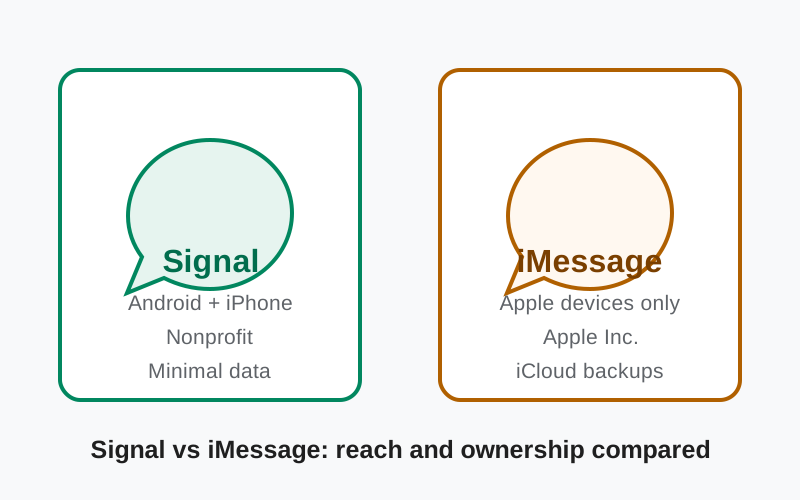
The two apps, side by side
| Signal | iMessage | |
| Owner | Signal Foundation, a US nonprofit | Apple, one of the world's largest tech companies |
| Business model | Donations and grants; no ads, no data business | Sells hardware and services; messaging supports device loyalty |
| Platforms | Android, iPhone, desktop | Apple devices only: iPhone, iPad, Mac. No Android app |
| Chat encryption | End-to-end encrypted by default, every chat and call | End-to-end encrypted between Apple devices |
| Open source | Client app open source; server code published | Closed source; Apple's claims rest on trust in Apple |
| Metadata collected | Minimal by design | Apple states iMessage is designed so it cannot read content; account and usage data still exists on Apple's systems |
| Registration | Phone number (usernames hide it from contacts) | Apple ID and phone number |
| Backups | Encrypted backups protected by a key only you hold | iCloud backups; end-to-end encrypted only with Advanced Data Protection turned on |
| Group chats | Fully encrypted groups | Encrypted groups between Apple devices |
Two rows do most of the work in this table: platforms and ownership. Everything else is detail around those two facts.
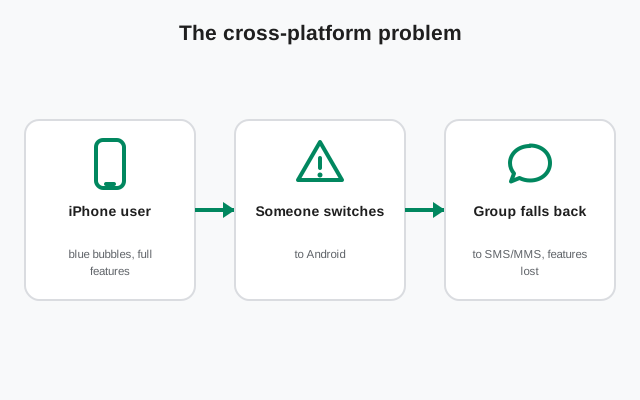
The cross-platform problem
iMessage cannot message Android
This is the whole comparison in one paragraph: iMessage cannot message Android phones. There is no iMessage app for Android, and Apple has shown no interest in making one. When an iPhone user texts an Android user, the conversation falls back to SMS or, on newer phones, to RCS, and the blue bubble turns green. Signal runs on both, so a Signal chat between an iPhone and an Android phone is fully encrypted end to end, with all the same features on both sides.
Reach matters more than features
This matters more than any feature list. A messenger is only as useful as the people you can reach with it. In countries and social circles where iPhones dominate, iMessage's Apple-only nature is invisible. In mixed-device families, workplaces, and most of the world outside Apple's strongest markets, it is a wall. Every green-bubble conversation is a conversation iMessage lost.
RCS fixed the look, not the privacy
Apple did add RCS support to iPhones, which improved texting with Android: photos look better and read receipts work. But carrier RCS is not end-to-end encrypted in the cross-platform case. Google's end-to-end encryption for RCS only applies between Google Messages users; chats between an iPhone and an Android phone over RCS do not get it. So the green bubble got prettier, but it did not get private. Our Signal vs RCS comparison goes deeper on exactly where RCS encryption stops.
Signal's answer to all of this is boring and effective: the same app, the same encryption, on every phone. Nobody has to switch platforms to talk privately.
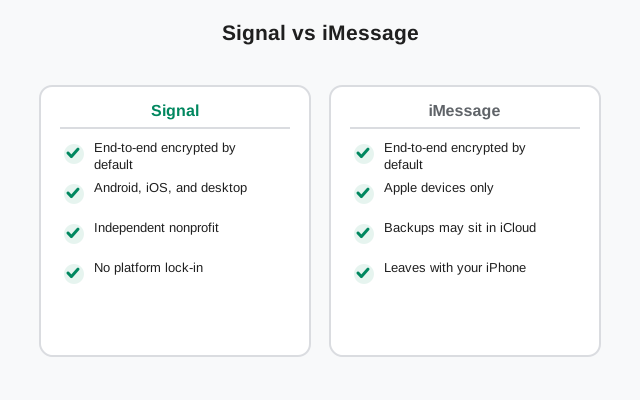
Encryption: both strong, different details
Let us give credit where it is due: iMessage's encryption is real end-to-end encryption between Apple devices. Apple cannot read the content of your iMessages in transit, and the cryptography has held up under years of scrutiny. Anyone who tells you iMessage is "not encrypted" is wrong. The honest comparison is about the edges around the encryption.
Verification. Signal shows you safety numbers for each contact so you can confirm nobody is intercepting your conversation, and it warns you when a contact's keys change. Apple added contact key verification for users facing serious threats, but for most people iMessage offers no equivalent ritual. You trust Apple instead. Apple is more trustworthy than most companies here, but trust is still not verification.
Scope. Signal encrypts everything by default: chats, group chats, voice calls, video calls, stories. iMessage encrypts messages and FaceTime calls between Apple devices. Both are comprehensive within their worlds; Signal's world is just bigger.
Openness. Signal's code is public, so independent researchers can check its claims. Apple's is not. When Apple says it cannot read your messages, you are taking Apple's word for it. That word has been reliable, but the difference between "trust us" and "check us" is the difference between these two apps' philosophies. Our guide to how Signal's encryption works explains what open verification looks like in practice.
Who owns your messenger
Signal is run by a nonprofit foundation. It has no shareholders, no advertising business, and no reason to learn anything about you beyond delivering your messages. Its funding comes from donations and grants. When the organization's incentives are privacy, privacy tends to win.
Apple is a for-profit company, but an unusual one for this comparison: it makes its money selling expensive hardware and services, not selling ads against your data. Apple has repeatedly positioned privacy as a selling point, and its business model genuinely supports that posture. Your iMessages are not feeding an ad-targeting machine.
So this is not a heroes-and-villains story. It is a structural one. Apple's privacy promises are business decisions that a future Apple could revisit. Signal's privacy is load-bearing: the organization cannot monetize your data because it built itself to not have it. One is a policy; the other is architecture. Policies change; architecture is harder to change.
There is also the question of what "your data" includes beyond message content. Apple holds your Apple ID, your device information, purchase history, and various usage data across its services. That is a far richer profile than Signal's near-empty records. None of it is your message content, but it is still you, and it still sits on company servers.
Backups and iCloud: the fine print
Backups are where good encryption quietly dies, and this is the one place iMessage users should actually pay attention. Here is the fine print, stated plainly:
If you back up your iPhone to iCloud, your message history in that backup is only end-to-end encrypted if you turn on Apple's Advanced Data Protection. Without it, Apple holds the keys to the backup, which means your messages are readable by Apple and obtainable with legal process. Advanced Data Protection is opt-in, buried in settings, and most iPhone owners have never heard of it. So the practical reality is that a large share of iMessage history sits in iCloud in a form Apple can read.
Signal's approach is stricter and less convenient, on purpose. Its backups are encrypted with a key only you hold. Lose the key and nobody, not even Signal, can restore your chats. There is no company-held copy as a fallback. That is the price of real encryption, and Signal charges it openly instead of hiding a readable backup behind a default setting.
Practical advice: if you stay on iMessage, turn on Advanced Data Protection today. It takes a few minutes and closes the biggest hole in Apple's privacy story. If you move to Signal, write down your backup key somewhere safe, like a password manager.
Features compared, honestly
Strip away the philosophy and compare daily use:
- Messaging basics: both excellent. Text, photos, video, voice messages, reactions, replies, disappearing messages. No meaningful gap.
- Calls: FaceTime is superb and deeply integrated into Apple devices. Signal's calls are fully encrypted, including group calls, and work across platforms.
- Groups: both handle groups well. Signal's groups are encrypted with admin controls and invite links; iMessage groups are smooth within the Apple world.
- Fun and expression: iMessage has the edge: stickers, effects, apps, Tapbacks, and years of polish. Signal covers the essentials and keeps adding, but it is not trying to win a cuteness contest.
- Desktop: iMessage on Mac is seamless if you live in Apple's world. Signal's desktop app works on any computer and links to any phone.
- Usernames: Signal lets you share a username instead of your phone number. iMessage ties you to your number and Apple ID.
- Stories: Signal has private stories; iMessage does not do stories at all.
The pattern will be familiar from our Signal vs WhatsApp comparison: the incumbent is the richer, more polished product inside its territory, and Signal is the more private, more portable one.
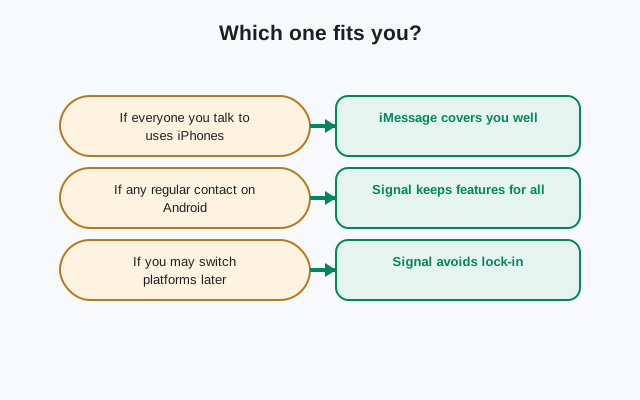
Who should pick which
| Your situation | The honest pick |
|---|---|
| Everyone you message uses an iPhone | iMessage, with Advanced Data Protection turned on. Convenient, encrypted, zero friction. |
| Your family or friends are split between iPhone and Android | Signal. It is the only way the whole group gets real encryption. |
| You want privacy from the company itself | Signal. Nonprofit, minimal metadata, verifiable code. |
| You are deep in Apple's ecosystem and like it | iMessage is fine. Just fix the backup setting. |
| You are a journalist, activist, or handle sensitive work | Signal. Verifiable encryption plus minimal metadata is the safer combination. |
| You want to hide your phone number from new contacts | Signal (usernames). iMessage always ties back to your number or Apple ID. |
| You switch between Android and iPhone | Signal. Your chats and contacts survive the platform hop. |
Notice the theme: iMessage wins when the world is all-Apple; Signal wins everywhere else. And "use both" is perfectly reasonable: iMessage for the Apple-only crowd, Signal for everyone else and for anything sensitive.
If Signal is your pick and your Android phone lacks the Play Store, our Signal APK download guide walks through getting the verified build straight from Signal. iPhone users can ignore all of that and just use the App Store.
Frequently asked questions
Is iMessage end-to-end encrypted?
Yes, between Apple devices. Apple cannot read the content of your iMessages in transit. The gap is backups: iCloud backups are only end-to-end encrypted if you turn on Advanced Data Protection.
Is Signal more private than iMessage?
For privacy from the company itself, yes. Signal is a nonprofit that collects minimal metadata and publishes its code. Apple does not monetize message content, but it holds far more data about you across its services, and its code is closed.
Can iMessage message Android phones?
No. There is no iMessage app for Android. Texts between iPhone and Android fall back to SMS or RCS, which are not end-to-end encrypted in the cross-platform case.
Is RCS between iPhone and Android encrypted?
Not end to end. Google's RCS encryption only applies between Google Messages users. Chats between an iPhone and an Android phone over RCS do not get that protection.
Should I turn on Advanced Data Protection?
Yes, if you use iCloud backups. It makes your iCloud data, including message history, end-to-end encrypted so Apple cannot read it. It is opt-in and most users never enable it.
Can I use Signal on an iPhone?
Yes. Signal has a full iPhone app with the same encryption as Android. Chats between Signal on iPhone and Signal on Android are fully end-to-end encrypted.
Related guides
- All Signal comparisons: the full compare hub
- Signal vs RCS: where RCS encryption actually stops
- Signal vs WhatsApp: our in-depth WhatsApp comparison
- How Signal encryption works: what open verification looks like
- Signal usernames and privacy: hiding your number from contacts