
Is Signal Really Private? An Honest, Complete Answer
Published: October 7, 2026 · Updated: October 8, 2026
The honest short answer: yes, for message content and most metadata, Signal is about as private as a mainstream messaging app gets. Messages are end-to-end encrypted, the service is designed to know as little as possible about you, and the code is open for inspection. But no app can protect a compromised phone, your own screenshots, or habits like posting your number in public. This page gives the balanced version, what Signal does well, where the limits are, and who it is actually right for.
from Signal’s official site — file hosted by Signal, not by us
What Signal does well
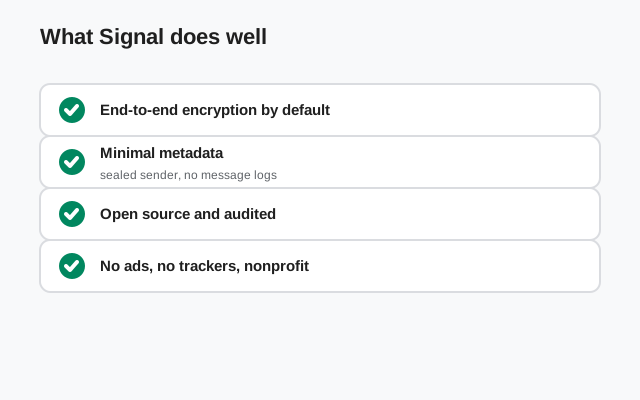
Start with the strong parts, because they are genuinely strong. Your messages are end-to-end encrypted with the Signal Protocol, which means the contents are readable only on the sender's and receiver's devices. Signal's servers relay encrypted blobs they cannot read. This is not a marketing claim about intent, it is a property of the encryption design, and the protocol is public and widely studied. The encryption guide explains the mechanics in plain language.
Beyond message content, Signal minimizes what it learns about your conversations. Sealed sender hides who is messaging whom from Signal's own servers, so even the service cannot easily build a map of your contacts. The company has said publicly that it stores very little: your phone number, profile information you set, your registration date, and the date you last connected. No message contents, no contact lists, no call logs of who you spoke to. The metadata breakdown lists exactly what is kept and what is not.
Two more strengths worth naming. The apps are open source, so the privacy claims can be checked against the actual code rather than taken on trust. And disappearing messages let you set conversations to delete themselves after a chosen time. This helps not because the encryption is weak, but because old messages on a device are a liability that no encryption can fix once someone holds the phone.
The honest limits
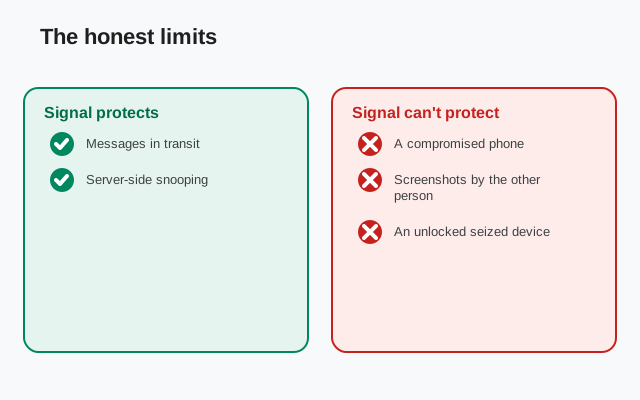
Now the part cheerleaders skip. Signal encrypts messages in transit and at rest on its servers, but the messages are decrypted on your phone, they have to be, so you can read them. That means everything on the device is only as safe as the device itself. A compromised phone, spyware, or someone with your unlocked device in their hands defeats every protection Signal offers. No messaging app can fix an untrusted endpoint, because the endpoint is where the secrets live.
The second limit is the people in your conversations. Screenshots, forwarded messages, and a contact who shows your chat to someone else are outside any app's control. End-to-end encryption protects the pipe, not the people at the ends of it. Disappearing messages reduce this risk; they do not eliminate it, because a recipient can photograph the screen before the timer runs out.
The third limit is the network around you. Your internet provider or mobile carrier can see that your device connects to Signal's servers and when, even though they cannot see what you say. In a group chat, every member knows the other members exist. And your phone's operating system, notification previews, and backups are all part of the picture Signal does not control. These are not flaws in Signal, they are boundaries of what any app can do.
The subpoena reality
One practical test of a privacy claim is what happens when a government demands data. Signal has published its responses to such requests, and the pattern is consistent: the company hands over the little it has, account creation date, last connection date, because that is all there is to hand over. There are no message contents to surrender, no contact graphs, no location history, because the service never collected them.
This is the meaningful sense in which Signal is "really private": privacy by design rather than by promise. A company can change a promise. It cannot hand over data it never stored. That said, keep the boundary in mind, this protects you against demands aimed at Signal's servers. It does not protect a device seized from your pocket, which is a separate threat handled by device encryption, strong lock screens, and disappearing messages.
Who it is right for, and not
Think in terms of threat models, kept practical. Ask: who are you trying to keep out, and what can they actually do?
Signal is right for you if you want your conversations private from companies, data brokers, advertisers, and dragnet surveillance. Journalists protecting sources, activists organizing, doctors and lawyers handling sensitive client talk, and ordinary people who simply prefer that a corporation not read their messages, all of these are squarely inside Signal's design. It is also right if you want to stop feeding the advertising machine the details of who you talk to and when.
Signal is not enough by itself if your threat includes a compromised device, spyware on your phone, or someone physically taking the device from you and compelling you to unlock it. It is also not the answer if the risk is a conversation partner you do not fully trust, no encryption fixes an untrustworthy recipient. In those cases Signal is still better than the alternatives, but the real fixes are device hygiene, careful contact choices, and legal advice, not a different app.
What "really private" means
People mean different things by "private," and most disappointment comes from mismatched definitions. Here is a clean way to split it.
| Kind of privacy | Does Signal deliver it? |
|---|---|
| Message content hidden from the service and outsiders | Yes, end-to-end encryption by design |
| Who talks to whom hidden from the service | Largely, sealed sender and minimal metadata |
| Your data not sold or used for ads | Yes, there is no advertising business to feed |
| Protection if your phone is compromised | No, no app can do this |
| Protection against untrustworthy contacts | No, screenshots and forwarding exist |
| Your number hidden from other users | Yes, with settings, see the number-hiding tour |
Notice what tops the "yes" column: everything about the service and the network. That is the part of the privacy problem an app can actually solve, and it is where most competing apps are weakest. The "no" column is the part no app can solve, which is why honest marketing in this space talks about threat models instead of absolute claims.
The pattern: Signal is excellent at keeping the service, the network, and third parties out of your conversations. It cannot keep out the device itself or the people you talk to. Anyone promising more than that is selling you something.
A decision framework
Three questions, answered honestly, tell you whether Signal fits your situation.
Who is the adversary?
If it is companies, data brokers, or mass surveillance, Signal is an excellent fit. If it is someone with access to your physical device, you need device-level defenses first.
Who are you talking to?
Signal protects the channel, not the contacts. If every person in the conversation is trustworthy, the privacy is real. If not, disappearing messages and careful sharing matter more than the app choice.
What does your setup leak around the app?
Notification previews on the lock screen, unencrypted cloud backups of the phone, a number posted in public bios, fix these alongside the app, or the app's privacy is undermined by everything around it.
Bottom line: Signal is really private in the ways that matter most to most people, and honestly limited in the ways every app is limited. Use it with the settings locked down, keep your device clean, choose your contacts carefully, and you get the privacy it promises, which is a lot. For how it compares to the app most people are switching from, the WhatsApp data comparison lays out the difference.
Frequently asked questions
Is Signal really private?
For message content and most metadata, yes, end-to-end encryption, sealed sender, and minimal data storage are real design properties, not promises. The honest limits: a compromised device, untrustworthy contacts, or your own habits can still expose you.
Can Signal read my messages?
No. Messages are end-to-end encrypted, so only the sender's and receiver's devices can read them. Signal's servers relay encrypted data they cannot decrypt.
What data does Signal have about me?
Very little, by the company's own public statements: your phone number, profile info you set, registration date, and last-connection date. No message contents, no contact lists.
Is Signal safer than WhatsApp?
For privacy from the service itself, yes, the difference is metadata. Both encrypt message content, but WhatsApp collects far more data around the messages. The comparison page breaks it down.
Can the government force Signal to hand over my chats?
They can demand data, but Signal can only hand over what it stores, basic account dates, not message contents. That is the practical meaning of privacy by design.
Keep reading
- hiding the sender too: sealed sender explained
- the metadata breakdown: what Signal stores
- the encryption underneath: encryption beginner's guide
- the WhatsApp data comparison: what WhatsApp collects