
The Signal Protocol Explained: How the Design Protects You
Published: October 7, 2026 · Updated: October 8, 2026
The Signal Protocol is the encryption engine underneath Signal’s chats, calls, and media. It combines two ideas. X3DH lets two phones agree on a shared secret even when one of them is offline. The Double Ratchet then gives every message a fresh key, so a stolen key only ever opens a tiny slice of the conversation. The design is open source, it has been reviewed by independent security experts again and again, and it is the same protocol WhatsApp and Google Messages rely on for their encryption.
from Signal’s official site — file hosted by Signal, not by us
Why does the protocol matter?
Most people never think about messaging protocols, and that is fine. But the protocol is the part of a messenger that decides what is mathematically possible and what is not. Marketing can promise privacy. Only the protocol can deliver it, because the protocol defines who holds the keys, how keys change, and what an attacker would need to break in. Signal’s reputation rests less on the company’s promises and more on this design being public, studied, and copied by others.
The Signal Protocol is a recipe for end-to-end encrypted conversation. It answers three hard questions: how do two strangers agree on a secret over a network full of watchers, how do they keep that secret fresh across thousands of messages, and how do they recover if a secret leaks. The answers have names: X3DH for the first, and the Double Ratchet for the second and third.
What problem does the Signal Protocol solve?
Imagine you want to message someone you have never met, who might be asleep, whose phone might be off, and who lives on the other side of the planet. You need a shared secret key, and you need it now, without either of you typing in a password or meeting in person. Older secure-messaging designs required both people to be online at the same time to shake hands. That does not work for a messaging app where half the world is asleep at any moment.
The Signal Protocol was designed for exactly this reality: asynchronous messaging. You can start a fully encrypted conversation with someone who is offline, on the first message, with no round trip. Then, as the conversation flows, it keeps the encryption fresh message by message and heals itself if anything leaks. No other widely deployed design does all three this cleanly, which is why the protocol spread far beyond Signal itself.
What is X3DH, in plain English?
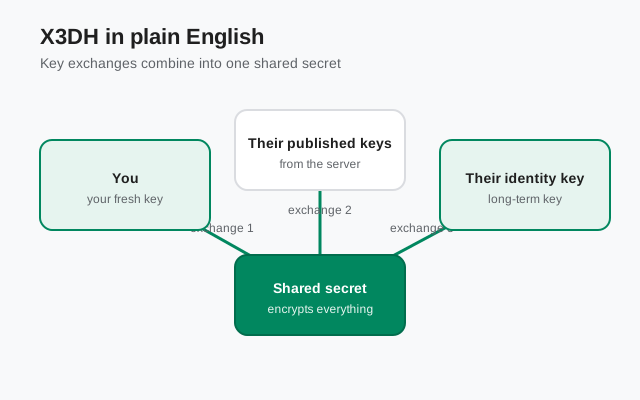
X3DH stands for Extended Triple Diffie-Hellman. Strip away the name and it is a clever way for two phones to agree on a secret without ever sending the secret anywhere.
An old math trick
The building block is an old mathematical trick. Two people can each pick a secret number, do some public math with each other’s public values, and end up with the same shared result, while anyone watching the public values learns nothing useful. The classic analogy is mixing paint: you and a friend each mix your secret color into a common base and exchange the mixtures. A watcher sees both mixtures but cannot unmix them to find your secret color. Yet when you each add your own secret color to the other’s mixture, you both end up with the same final shade.
Mixing three times
X3DH does this mixing three times over, combining three different key pairs: your identity key with their signed key, your one-time key with their identity key, and your one-time key with their signed key. The “triple” part means the final secret depends on long-term identity keys on both sides, which also proves who you are talking to. It is the identity keys being part of the mix that ties the encryption to the person, and that is what safety numbers later let you verify.
The extended part: solving the offline problem
The “extended” part solves the offline problem. Signal’s server holds a small stack of one-time public keys for every user. When you message someone new, your app grabs one of their one-time keys from the server and does the X3DH math immediately. The other person’s phone does its half when it wakes up. One-time keys are used once and deleted, so even if an attacker later steals a phone, they cannot replay old handshakes.
What is the Double Ratchet?
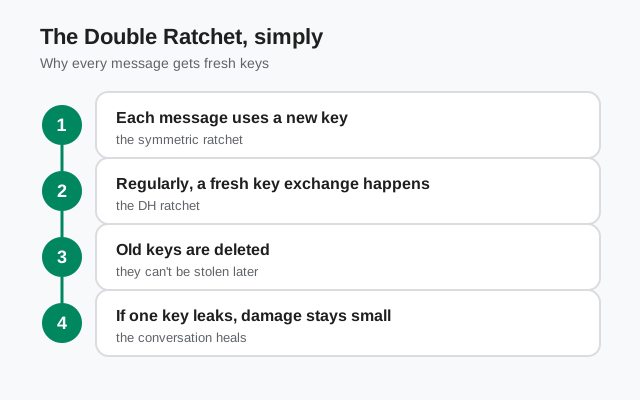
X3DH gets the conversation started. The Double Ratchet keeps it safe for the next ten thousand messages. A ratchet is a one-way mechanism: it moves forward easily and cannot move backward. The protocol runs two of them.
The first ratchet is the symmetric-key ratchet. From the shared secret, each side derives a chain of message keys, one per message. Sending a message uses the next key in the chain and then deletes it. This is what gives every message its own fresh key, and it is why a stolen key cannot open yesterday’s messages: those keys are gone, and the math only runs forward.
The second ratchet is the Diffie-Hellman ratchet. Every time the conversation changes direction, you reply to me, I reply to you, the two phones mix in brand-new key material. Each round trip produces keys the other side has never seen and could not have predicted.
Why two? The first ratchet protects the past. The second ratchet protects the future. Together they mean a leaked key opens a small window of messages and then the conversation moves on without the attacker.
What is forward secrecy, concretely?
Forward secrecy sounds abstract until you put a date on it. Suppose someone seizes your phone in March and manages to extract the encryption keys sitting on it. With an ordinary encrypted chat using one long-lived key, every message you ever sent would now be readable. With the Signal Protocol, the attacker gets the keys for the current moment only. February’s messages were encrypted with keys that were used once and deleted. They do not exist anywhere anymore: not on your phone, not on the other person’s phone, and never on any server.
This is the practical meaning of the per-message ratchet. Your conversation history is not one locked room with one key. It is a corridor of rooms, each with its own key, and each key is destroyed after its room is sealed. A thief who picks today’s lock finds one room, not the building.
What is post-compromise security?
Forward secrecy protects the past. Post-compromise security, sometimes called future secrecy, protects what comes next. Suppose an attacker briefly compromises your phone and copies the current keys, then loses access. Without the Diffie-Hellman ratchet, they could keep reading your new messages indefinitely using the stolen keys.
With the ratchet, the story is different. The next time you and your contact exchange messages, your phones mix in fresh key material the attacker never saw. Within a round trip or two, the conversation is encrypted under keys that exist only on the two real devices. The wound closes by itself. This self-healing is one of the properties that sets the Signal Protocol apart from simpler designs, and it happens silently in the background of every chat.
| Stage of a conversation | What happens | What it protects |
|---|---|---|
| First message to a new contact | X3DH handshake using their published one-time key | Works while they are offline; ties encryption to identity |
| Each message you send | A fresh message key is derived and the old one deleted | Forward secrecy: past messages stay sealed |
| Each back-and-forth exchange | New Diffie-Hellman key material is mixed in | Self-healing after a key compromise |
| Verifying the contact | Safety number comparison confirms the keys | No one sitting in the middleotocol really been audited?
Yes, in the sense that matters: the design is public, the code is open source, and independent security experts have reviewed it repeatedly over the years. One caution with the word “audited”: an audit is a snapshot, not a permanent certificate. It says qualified people looked hard at one version on one date. The honest claim is not “proven unbreakable” but “open and repeatedly scrutinized.” For the full history of what was reviewed and what the reviews found, see Signal’s independent security audit history. Who else uses the Signal Protocol?The protocol’s reputation shows in who adopted it. WhatsApp integrated the Signal Protocol starting in 2014 and completed end-to-end encryption across all its communication by 2016, including key verification for users. Google uses the Signal Protocol to provide end-to-end encryption for one-to-one conversations in Google Messages over RCS. Both are documented, public deployments, and both mean the same core design now protects billions of conversations a day beyond Signal’s own app. This matters for two reasons. First, it is independent validation: two of the largest messaging platforms on earth bet their encryption on this design rather than building their own. Second, it means the protocol gets battle-tested at enormous scale, in hostile network conditions, across every kind of phone. A design that survives that is not a lab experiment. One caution: using the same protocol does not make WhatsApp equal to Signal on privacy. The protocol protects message content. Everything around it, how much metadata is collected, how backups work, what the business model incentivizes, is a separate decision each company makes. The Signal vs WhatsApp comparison covers that full picture. What the protocol does not coverThe Signal Protocol is superb at its job, and its job has boundaries. It encrypts content between devices. It does not hide metadata from the server on its own. That is what sealed sender adds, by hiding the sender’s identity from Signal’s servers. It does not secure your phone against malware or physical seizure. That is device security. And it cannot stop the person you are talking to from sharing what you said. That is trust. Think of it as layers. The protocol seals the content. Sealed sender shrinks the metadata. Safety numbers verify the other end. Usernames hide your phone number. Each layer handles a different threat, and the protocol is the foundation they all stand on. The beginner’s encryption guide explains how the layers fit together without the technical detail. Frequently asked questionsIs the Signal Protocol open source?Yes. The protocol design is published and the implementations are open source, so independent researchers can inspect, test, and critique the design. Does WhatsApp really use Signal’s protocol?Yes. WhatsApp integrated the Signal Protocol from 2014 and completed end-to-end encryption for all communication in 2016. Google Messages also uses it for one-to-one RCS encryption. Has the Signal Protocol ever been broken?No practical break of the core design has been demonstrated. As with all cryptography, researchers continue to study it, and any future findings would be fixed in the open because the design is public. What is the difference between the Signal app and the Signal Protocol?The protocol is the encryption design: the math and message formats. The app is the software built on top of it, including servers, interfaces, and features like sealed sender and usernames. Other apps can use the protocol without being Signal. Do I need to understand the protocol to use Signal safely?No. The protocol works automatically. What helps is understanding the boundaries: verify safety numbers with important contacts, and remember that encryption protects the channel, not the device or the person. Keep reading
|